
CHINESE BULK MATCHA · BUYER SPECIFICATIONS · APPLICATION FIT
What Is Chinese Bulk Matcha? A Buyer Guide to Grades, Milling and Specifications
A B2B definition of Chinese bulk matcha covering raw materials, processing, supplier grade labels, milling, application fit and the specifications buyers should approve.
Chinese bulk matcha is commercial matcha produced in China and supplied in quantities suitable for food, beverage or tea-brand manufacturing. Buyers should not treat origin, a grade name or a bright powder photograph as a complete specification. A sound purchase connects the product definition and process route to measurable lot requirements, destination-market checks and performance in the intended latte, bakery, dessert, dry-mix or RTD system. The approved application and evidence package—not the label alone—should control the buying decision.
USE THIS GUIDE IF
- Ingredient importers, distributors and private-label tea brands comparing Chinese bulk matcha
- Beverage, bakery, dessert and dry-mix manufacturers writing a matcha specification
- Procurement, R&D and quality teams that need one shared approval method
NOT THE RIGHT ROUTE IF
- Consumer comparisons based only on ceremonial language or whisking ritual
- Buyers seeking a universal grade chart that every Chinese supplier must use
- Teams expecting origin or powder color to replace current lot documents and finished-product testing
PROJECT DECISIONS
Eight layers of a usable Chinese bulk-matcha specification
Start with a B2B definition, not a prestige story
For this guide, Chinese bulk matcha means matcha produced in China and sold as an ingredient in commercial quantities for another business to formulate, pack, distribute or serve. The definition says nothing by itself about sensory grade, organic status, export eligibility, factory scale or suitability for a particular application. Those questions require separate evidence. China's State Administration for Market Regulation lists GB/T 34778-2017, Matcha, as a current recommended national product standard. Its public record confirms that a national matcha standard exists and identifies its status and dates; it does not prove that every powder advertised as Chinese matcha conforms to the standard or to an importing country's requirements.
Bulk is also a commercial condition rather than a sensory grade. A buyer may need a powder for beverage premix, café latte, cookies, ice cream, chocolate, supplements or retail tea. The dose, process, packaging, target market and first order can be different in every case. Write the purchasing task before asking whether a sample is premium: who will use the powder, in what finished product, under which process, in which market, and against what release criteria?
Treat grade names as supplier classifications until translated
Terms such as ceremonial, premium, latte, foodservice and culinary can be useful inside one supplier's range, but they are not a universal equivalence table across China, Japan or the wider market. Two suppliers can use the same word for powders with different raw materials, color methods, sensory profiles, particle distributions, analytical limits and prices. Conversely, two differently named grades may perform similarly in one sweetened bakery system. A grade name should therefore open a specification conversation, not end it.
Ask the supplier to translate each grade into intended applications, sensory target, typical dose, physical and chemical parameters, analytical methods, packaging, storage and available lot documentation. Then compare representative samples under one controlled test. A useful shortlist can separate a tea-forward latte route, a heat-exposed bakery route and a cost-controlled premix route without claiming that one is universally better. The approved grade is the grade that meets the written commercial task with acceptable evidence and repeatability.
Trace raw material and leaf preparation before evaluating the powder
Matcha quality begins before milling. A buyer should ask about the leaf source, cultivar or controlled blend where disclosed, harvest window, shading practice, plucking standard, initial processing, stem and vein removal or refining route, storage and the lot linkage into the final powder. The public drafting explanation for China's proposed matcha production-processing standard says the existing GB/T 34778-2017 is a product standard and that the draft work addresses cultivar selection, shading, initial processing and refining. Because this document accompanies standard development, it is evidence of the subjects regulators and technical drafters consider important—not a final binding rule or proof of one supplier's process.
The same official drafting material identifies matcha production activity in several Chinese provinces, including Zhejiang, Guizhou, Jiangsu, Hubei, Hunan, Henan and Anhui. That establishes a broader production landscape, but not the output, ownership or capability of a named company. When origin matters, connect the quoted material to a processor, batch and traceability record. Our separate Guizhou sourcing guide examines one regional cluster and should be used for origin due diligence rather than turning this page into a competing Guizhou ranking article.
Milling is one control point inside a larger powder-handling system
Stone milling is strongly associated with matcha, but a procurement decision cannot be reduced to a photograph of millstones. Buyers need to understand the actual line used for the quoted item, the feed material, temperature and time controls where relevant, sieving or classification, foreign-material controls, dust management, environmental conditions, cleaning, line clearance, packing, retained samples and batch identification. Different equipment routes may be used for different commercial products. The supplier should describe the route accurately and connect it to measurable output rather than using a traditional image as a complete quality claim.
Particle size also needs a method. A single micron number without the instrument, sample preparation, distribution basis and tolerance is difficult to compare. Finer is not automatically better in every system: powder handling, dust, flow, wetting, mouthfeel and sediment behavior can move in different directions. Ask what is measured, how it is measured and which application result the limit is intended to protect. Then confirm it on representative production material rather than only a laboratory show sample.
Build the purchase specification in four connected layers
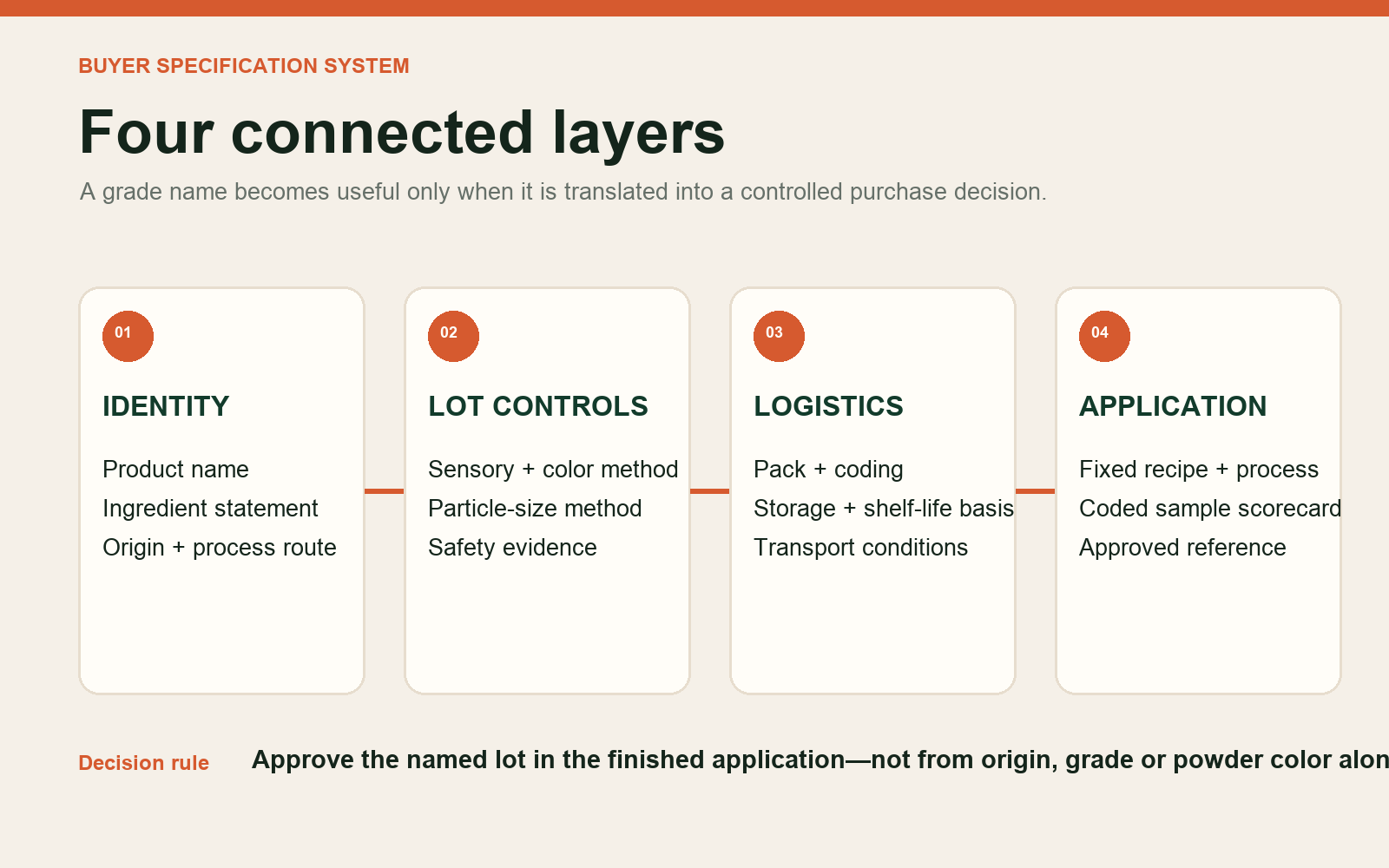
The first layer is identity: product name, ingredient statement, origin statement and process description. The second is measurable lot control: agreed sensory profile, color method, particle-size method, moisture and other relevant physical or chemical limits, plus microbiological and residue evidence appropriate to the product and destination. The third is logistics: pack material, net weight, coding, storage, shelf-life basis, pallet or case configuration and transport conditions. The fourth is application acceptance: an exact recipe, process and scorecard for the finished product.
Do not copy every possible test into the specification. Select criteria that protect identity, safety, processing and finished-product quality, assign methods and tolerances, and state which documents accompany each lot. Regulatory and customer requirements vary by market and food category, so the responsible importer or food business should confirm the final list with qualified advisers. A supplier certificate of analysis is evidence about the tested lot and listed methods; it is not a blanket guarantee for every destination, recipe or shelf-life condition.
Approve the powder in the application that will earn the order
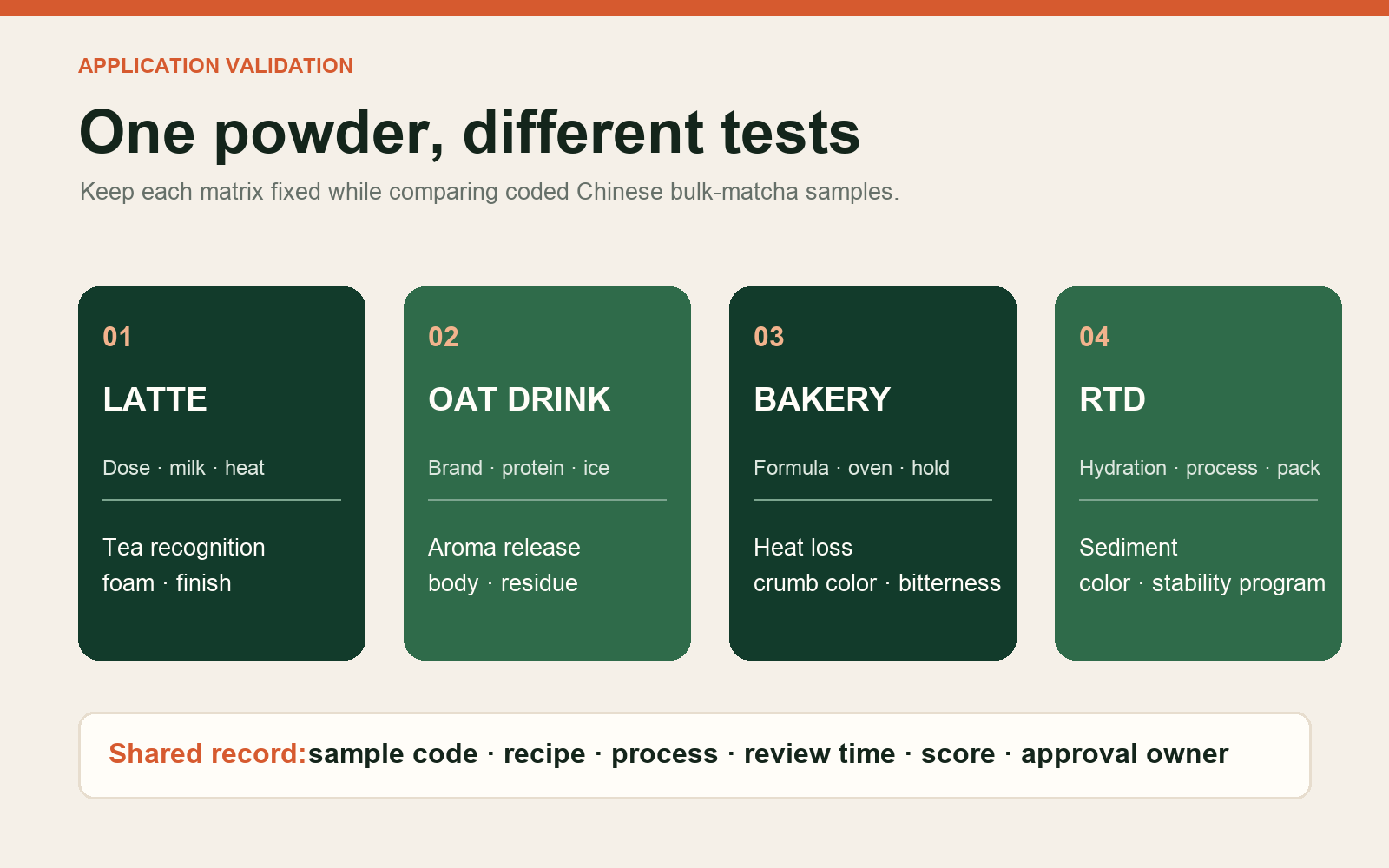
For a latte, freeze the matcha dose, water temperature and volume, dairy or plant beverage, sweetener, mixing order, equipment, ice and review time. For bakery, freeze the formula, batter process, oven profile, piece weight, cooling and packed evaluation point. For frozen dessert, define fat, sugar, overrun or process route and storage checkpoints. For RTD, the buyer's technical team must define hydration, homogenisation, heat treatment, package and stability program. One water whisking result cannot stand in for these matrices.
Use coded samples and score tea recognition, bitterness, astringency, aroma fit, color in the finished matrix, mouthfeel, dispersion or handling, process loss and aftertaste. Record cost-in-use at the approved dose rather than comparing only price per kilogram. Keep the winning sample, formula code, recipe, date, conditions and acceptance notes. If the buyer later changes the milk, sugar, thermal process or serving dose, that is a transfer check—not proof that the original approval was wrong.
Know what the official evidence proves—and what it cannot prove
The national standard record proves that GB/T 34778-2017 exists, is recommended rather than mandatory, and remains listed as current on the official platform. The processing-standard drafting explanation proves that a technical project has considered production topics and identifies reported production provinces. Neither source proves that a specific supplier follows the standard, owns a large factory, has a stated capacity, holds an export certification or can meet a buyer's limits. Those are company- and lot-level questions.
China's National Bureau of Statistics reported 3.92 million tonnes of total tea output in 2025. That figure describes all tea, not matcha, and should not be used as Chinese matcha production. Regional policy statements can identify a cluster or reported capacity at a particular date, but they should not be added together into a national matcha total without a compatible official methodology. Evidence quality improves when the claim, entity, period, unit and limitation are stated together.
Where XIAO TEA fits in a controlled bulk-matcha project
XIAO TEA is a custom flavored matcha specialist and professional B2B supplier. Our role is to connect a suitable matcha base with the buyer's finished application and flavor target, then structure sample comparison, adjustment and an approved-reference path. This is different from selling a catalogue grade on color and price alone. The difference should be verified through a written brief, coded samples, controlled application tests, an agreed specification and repeat-batch records—not accepted as a marketing promise.
XIAO TEA does not use regional statistics as its own capacity or export record. Buyers should review the manufacturing and company pages for the evidence currently published, request documents relevant to the proposed item and inspect further evidence during qualification. When custom flavored matcha is the project, the commercial path begins with the market, application, flavor direction, first volume and launch timing, and commercial production starts at one metric ton per approved flavor.
EVIDENCE BOUNDARY
A grade name is not a complete purchase specification.
Official standards and industry sources can define context. Supplier capability, lot conformity, destination-market suitability and application performance still require evidence tied to the named product and decision.
- Author
- XIAO TEA Application & Commercial Team
- Published
- 30 August 2026
- Review trigger
- Commercial terms, application evidence, regulatory sources or process scope changes
REFERENCE SOURCES
Official and primary references
- State Administration for Market Regulation — GB/T 34778-2017 Matcha standard record
- State Administration for Market Regulation — drafting explanation for the proposed matcha processing technical rules
- National Bureau of Statistics of China — 2025 agricultural production report
- Guizhou matcha industry sourcing and manufacturer guide
RELATED QUESTIONS
Questions buyers ask next
Is Chinese bulk matcha a single grade?
No. It is a commercial sourcing category. Grade labels vary by supplier and must be translated into intended use, measurable specifications, representative samples and application results.
Does GB/T 34778-2017 prove that a supplier's matcha is compliant?
No. The official record proves that the recommended national standard exists. Buyers still need evidence connecting the offered product and lot to agreed requirements.
Is stone-milled matcha automatically better for industrial use?
No universal conclusion is responsible. Confirm the actual milling and powder-handling route, measurement methods and performance in the intended product.
What should a first Chinese bulk-matcha RFQ include?
Include product and market, application recipe and process, sensory target, first volume, packaging, required documents, analytical limits, launch timing and approval owners.