CHINA TEA EXPORT DATA · HS CODES · MATCHA SOURCING METHOD
How to Read China Tea Export Data for Matcha Sourcing
A buyer method for reading Chinese customs and trade data without mislabeling broad tea or green-tea totals as matcha exports.
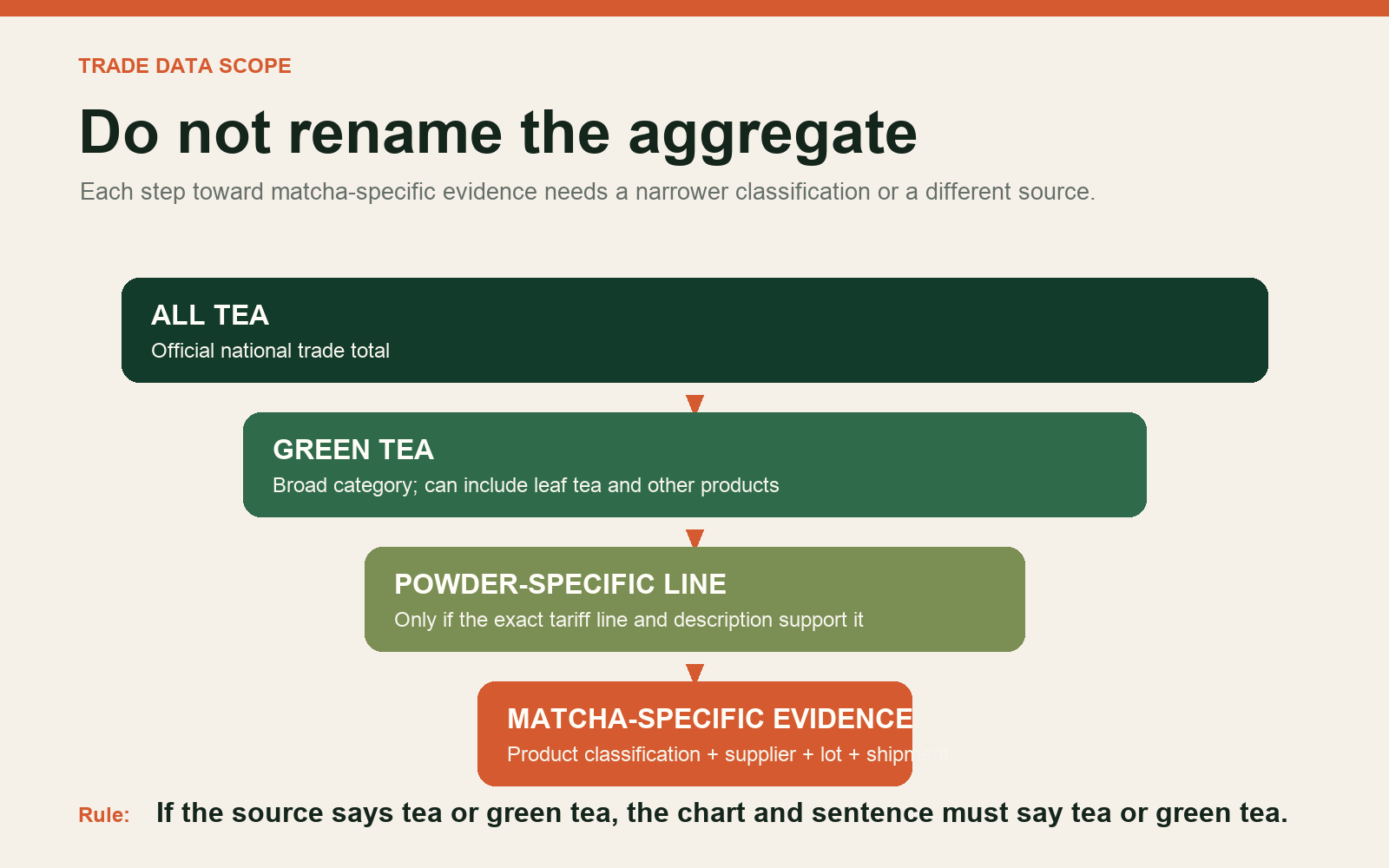
Public China trade reports can establish the scale and direction of tea or green-tea exports, but they do not automatically provide a clean matcha-only total. Buyers must read the HS level, product wording, reporting period, quantity unit, currency, destination and exporter-location field before using a number. When the public category includes leaf tea or other powders, report it as the published aggregate—not as Chinese matcha exports—and verify the exact product classification with the supplier, customs broker and destination authority.
USE THIS GUIDE IF
- Matcha importers and distributors checking Chinese trade claims
- Procurement and strategy teams using customs data to shortlist supply markets
- Analysts who need a repeatable method for separating official facts from inference
NOT THE RIGHT ROUTE IF
- Anyone seeking a fabricated matcha market-size number from a broad tea category
- Teams using province-of-export data as proof of agricultural origin or factory ownership
- Importers treating an HS code as a substitute for destination compliance and product documents
PROJECT DECISIONS
Eight fields to record before quoting a China tea-export number
Begin with the decision the data must support
Trade data can answer useful sourcing questions: Is China an established tea exporter? Which broad tea category dominates a published report? Which destination or customs territory receives the reported goods? Which exporter-location provinces appear in a monthly table? It cannot, without a suitable classification and methodology, prove the output, market share, capacity or export record of one matcha supplier. Start by writing the question and the minimum product scope needed to answer it.
If the decision is whether to qualify a Chinese matcha supplier, national export data is context. The controlling evidence remains the quoted product, ingredient and process description, origin and traceability, current lot documents, destination-market checks, application sample and commercial terms. If the decision is market sizing, a category that includes leaf green tea is too broad to be renamed matcha. It may still be reported honestly as an upper-level tea indicator with a clear limitation.
Read the HS hierarchy before reading the number
The Harmonized System is hierarchical. At the international four-digit heading level, HS 0902 covers tea, whether or not flavoured. Lower subheadings distinguish forms such as green tea in immediate packings of a stated size and other green tea. National tariff schedules can add more digits for customs administration. Product composition, packaging and the applicable national schedule determine the operational classification; a marketing name on a web page does not.
The World Customs Organization publishes the HS nomenclature framework, while China's customs and trade portals provide current tariff-number and classification-query routes. A buyer should record the full code actually used, the code version, the declared description, pack form and destination treatment. If a powder contains sugar, dairy ingredients, carriers or other components, do not assume it follows the same code as pure matcha. Ask a qualified customs broker or the responsible authority for a classification decision when the treatment is material.
Use the 2024 customs total as all-tea context—not matcha volume
China's Ministry of Commerce tea-export report for December 2024 records approximately 374,000 tonnes of tea exports for the full year with a value of about USD 1.42 billion. The published product label is tea. The number is useful evidence that China participates at scale in international tea trade. It is not a matcha-only quantity, does not establish how much powder was exported and cannot be assigned to XIAO TEA or any other supplier.
When citing the figure, keep product label, period, quantity, unit, value and source together: 2024, tea, approximately 374,000 tonnes, about USD 1.42 billion, MOFCOM. Do not shorten it to 'China exported 374,000 tonnes of matcha.' If a secondary article uses that wording, return to the official report. A source can be official and still be too broad for the claim a marketer wants to make.
A current monthly report shows how category scope changes the story
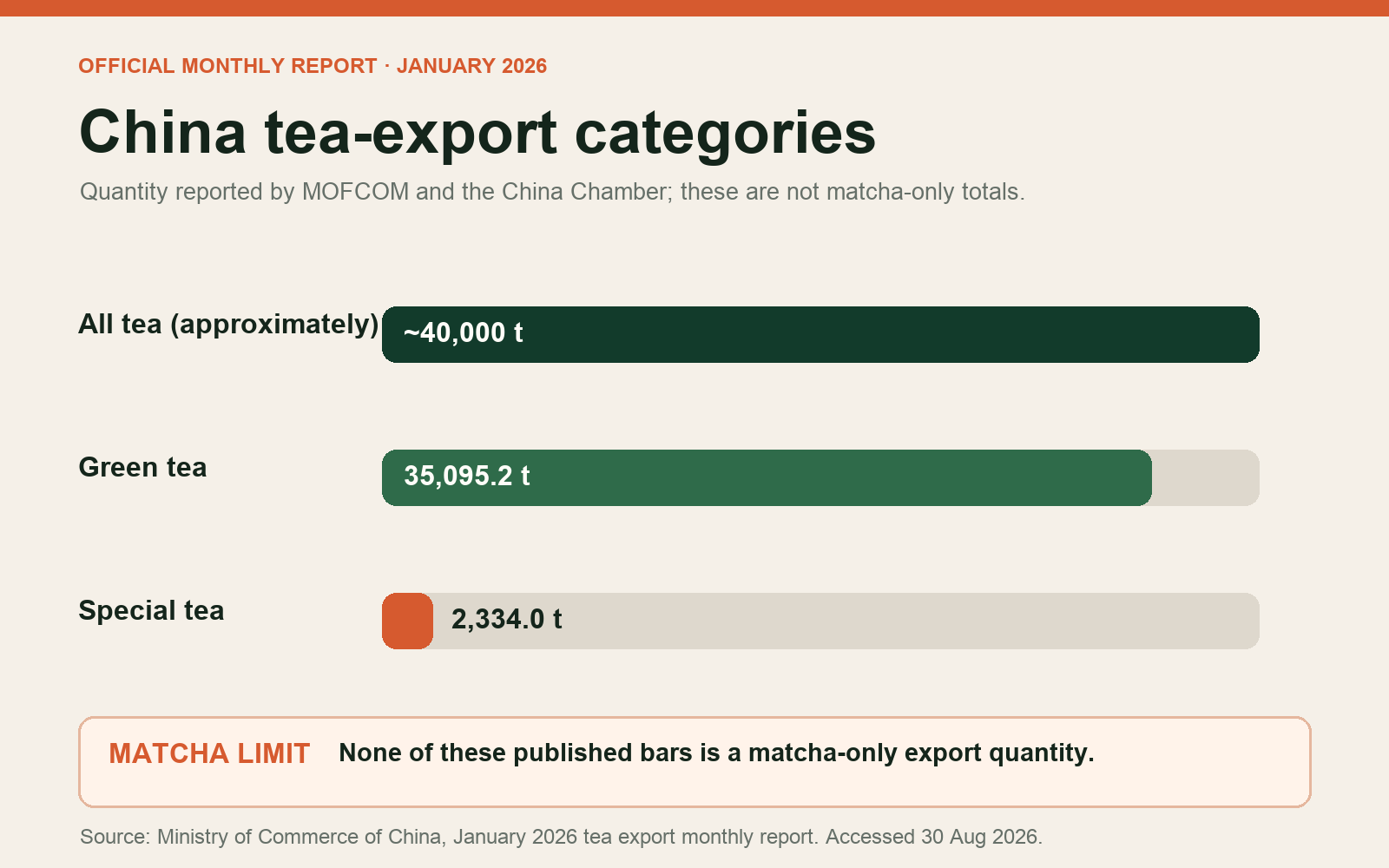
The Ministry of Commerce and the China Chamber of Commerce of Foodstuffs, Native Produce and Animal By-products published a January 2026 tea-export report. It records approximately 40,000 tonnes of all tea exports worth about USD 150 million, at an average unit value of USD 3,871.3 per tonne. Within the report, green tea is listed at 35,095.2 tonnes and USD 128.066 million, with an average unit value of USD 3,649.1 per tonne. A separate 'special tea' line is 2,334.0 tonnes and USD 15.646 million.
These are the report's trade categories, not three matcha grades. The all-tea total is rounded, while detailed lines carry more precision. The report says all-tea quantity was down 8.9 percent year on year, value up 1.9 percent and average unit value up 11.8 percent; that is one month compared with January 2025, not an annual trend forecast. The green-tea line can include products beyond matcha, so it must not be relabeled as January Chinese matcha exports.
Do not confuse exporter location, production origin and supplier ownership
The same January 2026 report lists tea exports by provincial exporter location, including Zhejiang, Anhui, Hunan, Hubei, Fujian, Jiangxi and Guizhou. This can indicate where exporting entities declared goods in the reporting system. It does not necessarily identify where every leaf was grown, where every powder was milled or which factory owns the volume. A company can source across regions, process in another location or export through a trading entity.
Record the field exactly as the source describes it. If the report says export location, do not title a chart production origin. To verify matcha origin, request traceability and processing records for the offered lot. To verify supplier export experience, request appropriately redacted shipment evidence or other auditable records from the named company. National and provincial aggregates are not a substitute for company-level due diligence.
Apply a reproducible five-step buyer data method
First, preserve the official source URL or file, publication date and access date. Second, copy the product wording and full classification level rather than paraphrasing it. Third, record period, quantity unit, currency, value basis and any conversion or calculation. Fourth, identify the geography field—China total, destination, customs territory or exporter location. Fifth, add one limitation sentence and one buying implication. This creates a record another buyer can reproduce.
For example: 'The January 2026 MOFCOM report lists 35,095.2 tonnes of green-tea exports. This category is broader than matcha, so it is used here only to describe the surrounding export category. Matcha supplier qualification still requires product classification, lot evidence and shipment-specific checks.' If combining periods or calculating shares, save the underlying values and formula. Do not mix rounded totals with precise sub-lines without noting the difference.
Separate market context from shipment and destination checks
A customs category does not confirm that a proposed shipment meets pesticide, microbiological, contaminant, ingredient, allergen, organic, labeling or import-entry requirements in the destination market. Those obligations depend on the product, intended use, formulation, claims, importer role and current rules. The buyer should define the destination evidence set before commercial approval and confirm classification and documentation with qualified customs and regulatory partners.
Likewise, unit value in an aggregate report is not a quotation for matcha. It averages the declared value and quantity inside the reported category, which can contain products of different types, qualities, packs and contract terms. It should not be used to challenge a supplier price without matching product identity, grade, specification, package, volume, incoterm, service scope and date. Trade data helps frame questions; it does not remove the need for a comparable offer.
How XIAO TEA should use trade evidence in a buyer conversation
XIAO TEA uses public trade data to explain market context and help buyers ask better questions, not to claim national totals as our exports. We are a custom flavored matcha specialist and professional B2B supplier. For a qualified project, we connect the intended market and application to matcha-base selection, flavor architecture, controlled sampling, application feedback and an approved-reference path. Supplier capability must be demonstrated with evidence tied to the quoted material and project.
A buyer brief should state the destination, responsible importer, pure-matcha or formulated-powder identity, intended use, package, first volume, required documents and launch timing. XIAO TEA can provide information for its supplied item and coordinate technical questions within the agreed scope. The importer and qualified advisers remain responsible for classification, entry, finished-product compliance and market release. This boundary is more useful than a large but mislabelled export number.
DATA LIMIT
A broad tea category must remain a broad tea category.
The cited figures describe the product scope named by each official source. They are not presented as matcha-only exports, XIAO TEA shipments, supplier capacity, market share or proof of destination compliance.
- Author
- XIAO TEA Application & Commercial Team
- Published
- 30 August 2026
- Review trigger
- Commercial terms, application evidence, regulatory sources or process scope changes
REFERENCE SOURCES
Official and primary references
- Ministry of Commerce of China — December 2024 tea export report
- Ministry of Commerce of China — January 2026 tea export monthly report
- World Customs Organization — HS Nomenclature 2022, Chapter 9
- China Customs — customs regulations and tariff classification query portal
- Ministry of Commerce of China — import and export tariff number query
- Ministry of Finance of China — 2024 tariff schedule (HS heading 0902)
RELATED QUESTIONS
Questions buyers ask next
Does China publish one reliable matcha-only export total?
The official public sources used here report broader tea or green-tea categories. Without a stable matcha-only classification and methodology, those totals must not be relabelled as matcha exports.
Can HS 0902 be used for every matcha product?
Do not assume so. HS 0902 is the tea heading, but the full operational code can depend on product composition, packaging and national schedules. Formulated latte powders may require different analysis.
Does a province-of-export table prove where the matcha was grown?
No. Exporter location, agricultural origin, processing location and supplier ownership are different fields. Verify origin and processing through lot traceability.
Can average tea export value be used as a bulk-matcha target price?
No. Aggregate unit values combine different products and commercial terms. Compare quotations only after aligning identity, specification, package, volume, incoterm and service scope.