Lot COA Review
How to Read a Bulk Matcha COA: A Lot-by-Lot Buyer Checklist
A field-by-field method for turning one bulk matcha certificate of analysis into a documented ACCEPT, HOLD, RETEST or ESCALATE decision without treating the COA as automatic lot release.

Read a bulk matcha COA by verifying identity before judging results: confirm the document, product, lot, sampling and test dates against the material you intend to receive. Then compare each analyte, method, unit, result, reporting limit and decision rule with the approved specification and destination requirements. Check how the sample represented the lot and whether the laboratory's relevant scope covers the matrix and method. A specification defines what must be met; a COA reports what was measured for one identified lot. It is one item of lot evidence, not automatic lot release.
USE THIS GUIDE IF
- Importers, food and beverage manufacturers, tea brands, chain procurement teams, quality managers and product developers reviewing a lot-specific COA for bulk matcha or custom flavored matcha.
- Buyer teams that need to reconcile one COA with the approved specification, product and lot identity, sampling chain, laboratory scope, destination review and application evidence.
- Organizations building a documented internal route for ACCEPT, HOLD, RETEST or ESCALATE decisions with named evidence, responsibility, disposition and closure records.
NOT THE RIGHT ROUTE IF
- A universal pesticide, microbiological, heavy-metal or contaminant limit table for every country, product classification or end use.
- A replacement for qualified laboratory interpretation, importer responsibility, destination-law review, statistical sampling design, food-safety hazard analysis or an authorized release procedure.
- Proof that any real supplier, laboratory, product or lot conforms, that one sample represents a whole lot, or that the powder will perform in a finished beverage, bakery, dessert or RTD application.
PROJECT DECISIONS
Ten checks before accepting, holding, retesting or escalating a bulk matcha lot
1. Confirm which document, product and lot the COA covers
Begin with document identity. A usable COA should be uniquely identifiable through fields such as a report or certificate number, revision status, issue date, issuing entity and complete page count. If a report has been corrected or reissued, retain the relationship between the superseded and current versions. A company letterhead or laboratory logo alone does not establish document authenticity, completeness or revision control.
Next, reconcile product and lot identity. The product name, SKU or material code, lot number, production date, sampling date, test date and report date should align with the purchase order, approved specification, package labels, shipping documents and received goods. Similar names do not prove that two powders are the same material. A development sample, pilot lot and commercial lot are not interchangeable. If a report says only “matcha powder” and provides no reliable mapping to the lot under review, place the lot on HOLD and resolve the identity gap before interpreting the numbers.
Check whether the shipment contains more than one production lot. A single COA cannot automatically be projected across other lots when the consignment includes several lot codes. The commercial agreement or quality agreement should define what constitutes a lot, which packages belong to each lot, how each lot is sampled and whether a separate COA or release record is required.
2. Read the approved specification, COA and decision rule as separate controls
The approved specification states what the buyer and supplier agreed the product must meet: identity, test items, targets or limits, methods, units, tolerances and acceptance rules. The COA reports results obtained for one identified lot under the methods shown. The documents must connect, but they do different jobs. Without an independently approved, version-controlled specification, a Pass printed on a COA may only refer to the supplier's internal criteria. The buyer cannot assume those criteria match its application, contract or destination obligations.
The decision rule is a third control. It explains how a result, specification limit, reporting limit and, where relevant, measurement uncertainty will be used to reach a conformity decision. Agree that rule before testing, particularly for results near a limit. Do not select a more favorable interpretation after seeing the number. Codex sampling guidance also distinguishes conformity assessment based on a measurement from acceptance sampling used to decide on a lot under a defined sampling plan. The four labels in this guide are procurement workflow states, not a replacement for a statutory or Codex acceptance-sampling decision.
Map every COA row back to the same item in the approved specification and verify the specification version. If the method, unit, limit, product definition or basis differs, pause the comparison. Do not round, convert or mix results from unlike methods merely to create a passing outcome. When conversion is technically justified, retain the original result, formula, basis, assumptions and reviewer approval.
3. Read every row: analyte, method, unit, result and reporting limit
The test item must be specific enough to interpret. Summary phrases such as “microbiology pass,” “pesticides compliant” or “heavy metals OK” do not identify the organisms or analytes tested, the methods used, the results obtained or the criteria applied. Required analytes should be listed individually where appropriate and linked to the product, intended use, destination and hazard assessment. A long list is not automatically a correct list, and no single panel establishes compliance everywhere.
The analytical method affects comparability. Differences in sample preparation, extraction, instrument conditions, culture conditions or reporting basis can produce results that should not be compared directly. The COA should provide a method identifier or sufficiently clear method description. If it states only “internal method,” request the method's intended scope, matrix suitability, validation status and relationship to the approved method. ISO/IEC 17025 provides a framework for laboratory competence, impartiality and consistent operation, but accreditation does not mean every analyte, matrix and method offered by that laboratory is within its accredited scope.
Units and reporting bases must match the specification. Confirm whether a value is reported on an as-is or dry-matter basis, per gram, per kilogram, per defined test portion or on another basis. A numeric result is generally more useful than Pass for trend and margin review when a numeric value is appropriate and available. Qualitative tests still need a defined reporting logic. Do not treat mg/kg and µg/kg, per-gram and per-25-gram results, or dry-basis and as-is values as equivalent.
4. Interpret ND, LOD, LOQ, Pass and borderline results correctly
ND, or not detected, generally means that the analyte was not detected under the method and reporting convention used. It does not mean absolute zero. A result reported as below LOD indicates a result below the method's stated detection capability. A result reported as below LOQ generally indicates that it is below the level at which the method can quantify with its stated performance, even though some response may be present. Definitions and calculation practices can differ by method and laboratory, so use the report's and laboratory's stated definitions rather than assuming universal values.
This is why an ND from one laboratory should not automatically be described as cleaner than a numerical result from another laboratory using a lower quantification limit. First compare the matrix, analyte, preparation, method, LOD, LOQ and reporting convention. If the method cannot measure low enough to answer the approved specification or destination question, an ND statement is not sufficient evidence for that decision.
Pass or Conforms is meaningful only when the basis is visible. Ask which specification version and destination criterion were applied, whether measurement uncertainty was considered, how rounding was handled and who made the conformity statement. If the report omits the actual result, specification or decision rule, treat the conclusion as incomplete information rather than automatic acceptance.
A borderline result lies close to a specification limit, reporting limit or buyer warning level. Follow the pre-agreed decision rule and risk assessment, not intuition. HOLD may be appropriate while the buyer requests uncertainty information, checks underlying records or arranges confirmation. An independent retest may be justified under an agreed representative sampling plan. A more favorable second result does not erase the first. Investigate sampling differences, within-lot heterogeneity, method differences, laboratory variation or document error, and document why the final disposition is supportable.
5. Trace the sample, laboratory and relevant accreditation scope
A COA describes the tested sample, not an abstract entire lot. Ask who sampled, where and when sampling occurred, how many increments were taken, how the laboratory sample was formed, how it was sealed and transported, and why it represents the lot. Codex CXG 50 explains that a sampling plan includes the way samples are taken, the sample size and the associated acceptance criteria, and that limited sampling carries both consumer and producer risks. One convenient bag, a development sample or an untraceable retained sample does not automatically represent a commercial lot.
The laboratory should be identifiable. If ISO/IEC 17025 accreditation is used as a confidence factor, verify the accreditation body, current certificate status and the actual scope covering the relevant laboratory location, food matrix, analyte and method. A logo is not a scope. Third-party tested is not a guarantee that a method was suitable or a sample representative. For high-risk or disputed results, a qualified reviewer may need the full laboratory report, method information, sample condition on receipt and relevant quality-control information.
In its specific U.S. importer context, FDA's FSVP guidance describes sampling and testing documentation that can include food and lot identity, number of samples, tests and analytical methods, test and report dates, results, corrective actions, laboratory identity and qualified-person documentation. It also cautions that a relied-upon test should use scientifically based sampling, a method suitable for the food matrix and sensitivity appropriate to the hazard. These points are useful for constructing a buyer checklist, but they are not a universal rule for every destination or transaction.
6. Let destination, product form and end use determine what needs testing
There is no single COA analyte-and-limit table that applies to every country, every matcha product and every end use. Pesticides, contaminants, heavy metals, microbiological criteria, additives, allergens and other checks depend on product classification, ingredients, process, destination law, importer responsibility, customer specification and intended use. The EU Pesticides Database is an official entry point for European Union pesticide checks, and Codex databases provide international standards context, but neither replaces product mapping, the competent authority for the actual destination or qualified advice.
Pure matcha and flavored matcha, a retail finished product and an industrial ingredient, or a directly consumed powder and one processed later may require different hazard and document reviews. Connect the COA panel to formulation, packaging, consumer group, processing steps and finished application. Moisture or microbiological results may form part of lot evidence, but they do not predict sedimentation in an oat beverage, color after RTD heat treatment, flavor retention in baking or the finished product's true shelf life.
China's GB/T 34778-2017 can support the limited statement that a Chinese matcha product standard exists within its stated scope and status. The standard number alone does not prove that a COA, lot or supplier conforms, and it does not replace destination requirements. Treat each standard, database and accreditation record as evidence with a defined purpose, not as a universal compliance badge.
7. Put the COA inside the evidence chain—and know what it cannot prove
An auditable lot-evidence chain may include an approved, version-controlled product specification; product and lot identity on production and packaging records; a pre-agreed sampling and test arrangement; the COA or complete laboratory report; buyer or independent confirmation when required; the approved sample and retained sample; application validation; deviation investigation; change records; and an authorized disposition record. The COA answers a narrow question: what results were reported for this sample under these methods. It does not independently establish supplier capability, consistency across all lots or compliance in every destination.
Under appropriate conditions, a COA can support that a named report maps to a named product and lot; the stated sample was tested for the listed items using the listed methods; the listed results were reported on stated dates; and a result may have been compared with a visible specification or decision rule. It cannot by itself prove that the sample represented the entire lot, that unlisted hazards were absent, that every destination requirement was met, that all manufacturing records were accurate, or that future lots will be consistent.
It also cannot by itself prove dispersibility, sedimentation control, post-heat color, actual flavor, performance in dairy or plant milk, baking behavior, RTD stability or true shelf life. Those questions require application tests, process conditions and stability designs relevant to the real product. Laboratory evidence and application evidence are parallel controls: neither substitutes for the other. When formulation, tea base, flavor system, packaging, process or production site changes, use change control to decide what must be resampled, retested and reapproved.
8. Make an ACCEPT, HOLD, RETEST or ESCALATE decision and retain the record
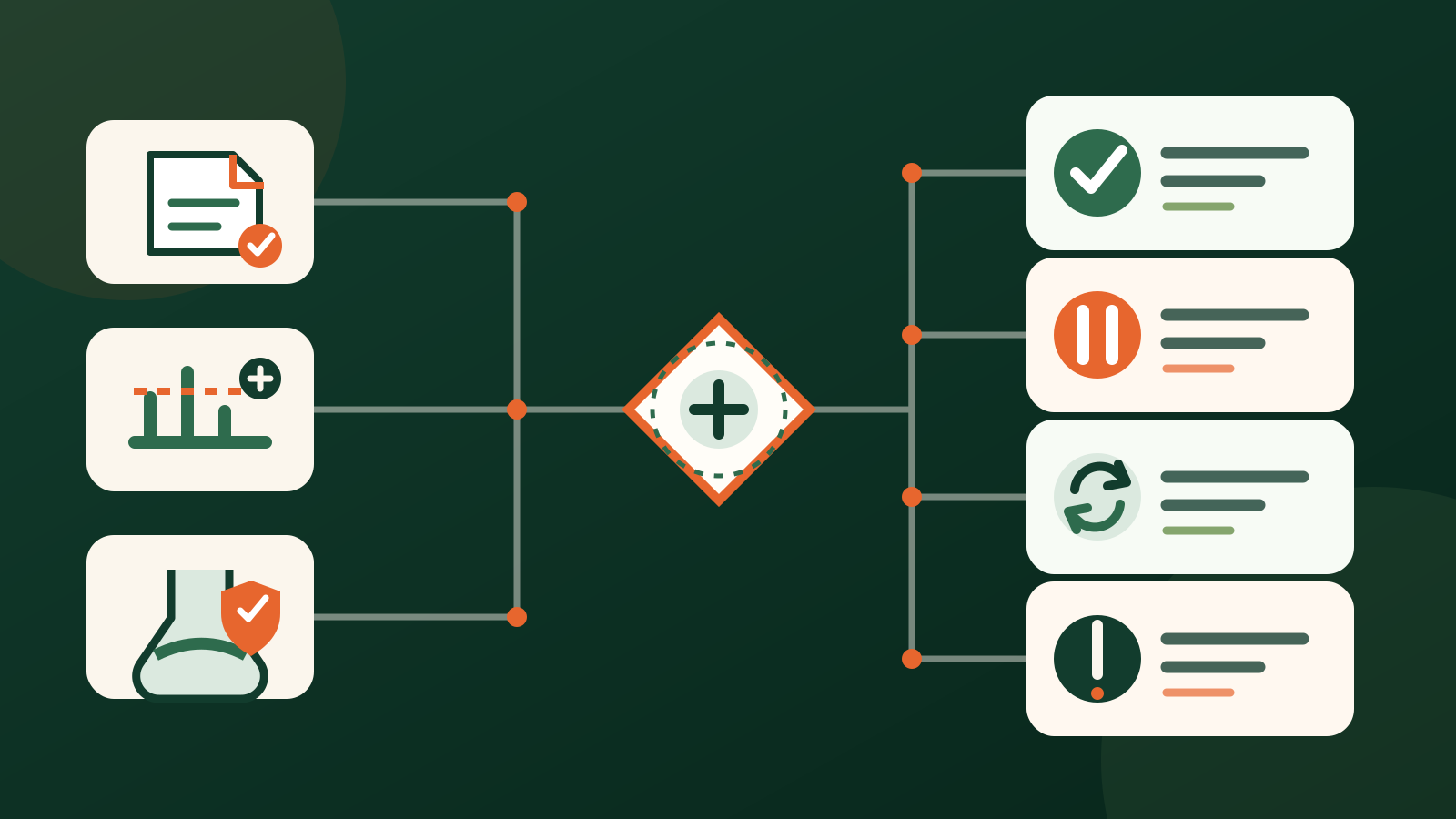
ACCEPT means that, under the buyer's authorized procedure, document identity, product and lot mapping, required analytes, methods, units, results, specification, decision rule, sample representativeness and other required evidence are sufficient to move to the next procurement or release step. It is not a legal decision made by this article. HOLD means do not release or advance yet. Common triggers include missing fields, uncertain revision status, lot mismatch, incomparable methods, borderline results or incomplete destination review.
RETEST is used to collect defined additional evidence when sample representation is weak, method capability is unclear, a report error needs confirmation or an anomaly requires independent verification. The retest plan should identify who samples, what is tested, which method and laboratory are used, and how disagreement between initial and confirmation results will be handled. ESCALATE is appropriate for out-of-specification results, destination-risk conflicts, document-integrity concerns, repeated deviations, laboratory-scope gaps, potential multi-lot impact, or a decision requiring quality, regulatory, importer and supplier management.
Record the decision date, product, lot, specification version, COA revision, finding, evidence reviewed, temporary controls, owner, final disposition and closure criteria. Do not delete an unfavorable report or retain only the final passing result. A complete record supports trend review, complaint investigation, recall readiness, supplier improvement and the next purchase decision.
XIAO TEA is positioned as a custom flavored matcha specialist and professional B2B supplier. For food and beverage manufacturers, established chains, tea brands and import buyers with a real scale-up plan, we can help connect the application brief, tea base and flavor direction, approved sample, product specification, COA fields, application tests and batch records into a clearer project-document chain. A custom flavor must still be tested in the buyer's actual dairy, plant-milk, bakery, dessert, premix or RTD conditions; it cannot be declared successful from a COA.
XIAO TEA does not replace the buyer, importer, third-party laboratory, accreditation body, regulatory adviser or competent authority in making final compliance or lot-release decisions. This guide makes no unsupported claim about XIAO TEA laboratory accreditation, certification, capacity or customer results. Test panels, methods, frequency and destination documents must be agreed for the actual product, risk, use and allocation of responsibility.
If you are reviewing a bulk or flavored matcha COA, use Request Project to submit a redacted description of the application, destination, approved specification version, lot mapping and COA fields that need clarification. XIAO TEA can help organize the next questions from an application-development and procurement-document perspective. Do not upload customer identities, complete formulas, bottom-line prices, private certificate keys or other confidential records.
EVIDENCE BOUNDARY
A COA can support a lot decision only within its identified sample, methods and decision rule.
The cited standards and regulatory resources support a method for asking better questions: identify the product and lot, retain sampling and test information, use fit-for-purpose methods, understand reporting limits and uncertainty, and review evidence according to the actual destination and risk. They do not prove that XIAO TEA or another supplier owns an accredited laboratory, that a particular report is authentic, that the sample represents the whole lot, that the lot complies everywhere, or that the product performs in a finished application. COA means a certificate or report for an identified sample or lot; an approved specification is the version-controlled set of requirements and decision rules; LOD concerns detection capability; LOQ concerns reliable quantification under stated performance; ND means not detected under the stated method and reporting convention, not absolute zero; and scope of accreditation means the locations, matrices, analytes, methods or capabilities actually covered by an accreditation decision. Project-specific documents, responsible reviewers and, where applicable, competent-authority or professional interpretation remain necessary.
- Author
- XIAO TEA Application & Commercial Team
- Published
- 1 September 2026
- Review trigger
- Commercial terms, application evidence, regulatory sources or process scope changes
REFERENCE SOURCES
Official and primary references
- State Administration for Market Regulation — National Standards Full-text Disclosure System, GB/T 34778-2017 Matcha
- ISO — ISO/IEC 17025:2017, General requirements for the competence of testing and calibration laboratories
- ISO — Official laboratory explainer for ISO/IEC 17025 testing and calibration laboratories
- Codex Alimentarius — CXG 50-2004, General Guidelines on Sampling
- Codex Alimentarius — CXG 54-2004, Guidelines on Measurement Uncertainty
- Codex Alimentarius — CCMAS related standards gateway
- Codex Alimentarius — International food standards databases
- European Commission — EU Pesticides Database
- U.S. FDA — Foreign Supplier Verification Programs for Importers of Food for Humans and Animals, Guidance for Industry
- U.S. FDA — Foreign Supplier Verification Programs Key Requirements
RELATED QUESTIONS
Questions buyers ask next
What is the difference between a bulk matcha specification and a COA?
The approved specification defines what one identified product must meet, including methods, units, tolerances and decision rules. A COA reports what was measured for one identified lot under the methods shown. They must connect, but a COA cannot replace the specification and is not automatic lot release.
Does ND on a matcha COA mean the analyte is zero?
No. ND means not detected under the stated method and reporting convention. Interpret it with the actual matrix, method, LOD, LOQ and reporting limit. A method that cannot measure low enough for the approved decision may still report ND without providing sufficient evidence.
Can one bulk matcha COA prove compliance in every country?
No. The required panel and limits depend on product classification, ingredients, process, destination law, importer responsibility, customer specification and intended use. Codex, EU, U.S. and Chinese sources each have defined scopes and do not create one global COA limit table.
When should a buyer retest a bulk matcha lot?
RETEST may be appropriate when sample representativeness is weak, method capability is unclear, a report error needs confirmation or an anomaly requires independent verification. Define who will sample, the plan, analytes, method, laboratory and how conflicting initial and confirmation results will be investigated and decided.
Can a COA prove matcha performance or shelf life in the finished product?
No. A COA cannot by itself prove dispersion, sedimentation control, post-heat color, actual flavor, dairy or plant-milk behavior, baking performance, RTD stability or true shelf life. Those questions require application tests, real process conditions and an appropriate stability design.