Supplier Evaluation
Bulk Matcha Supplier Evaluation Framework: Evidence Gates Before Scoring
Evaluate bulk matcha suppliers through evidence gates for legal identity, site and scope, traceability, COA, destination risks, change control and scale-up.
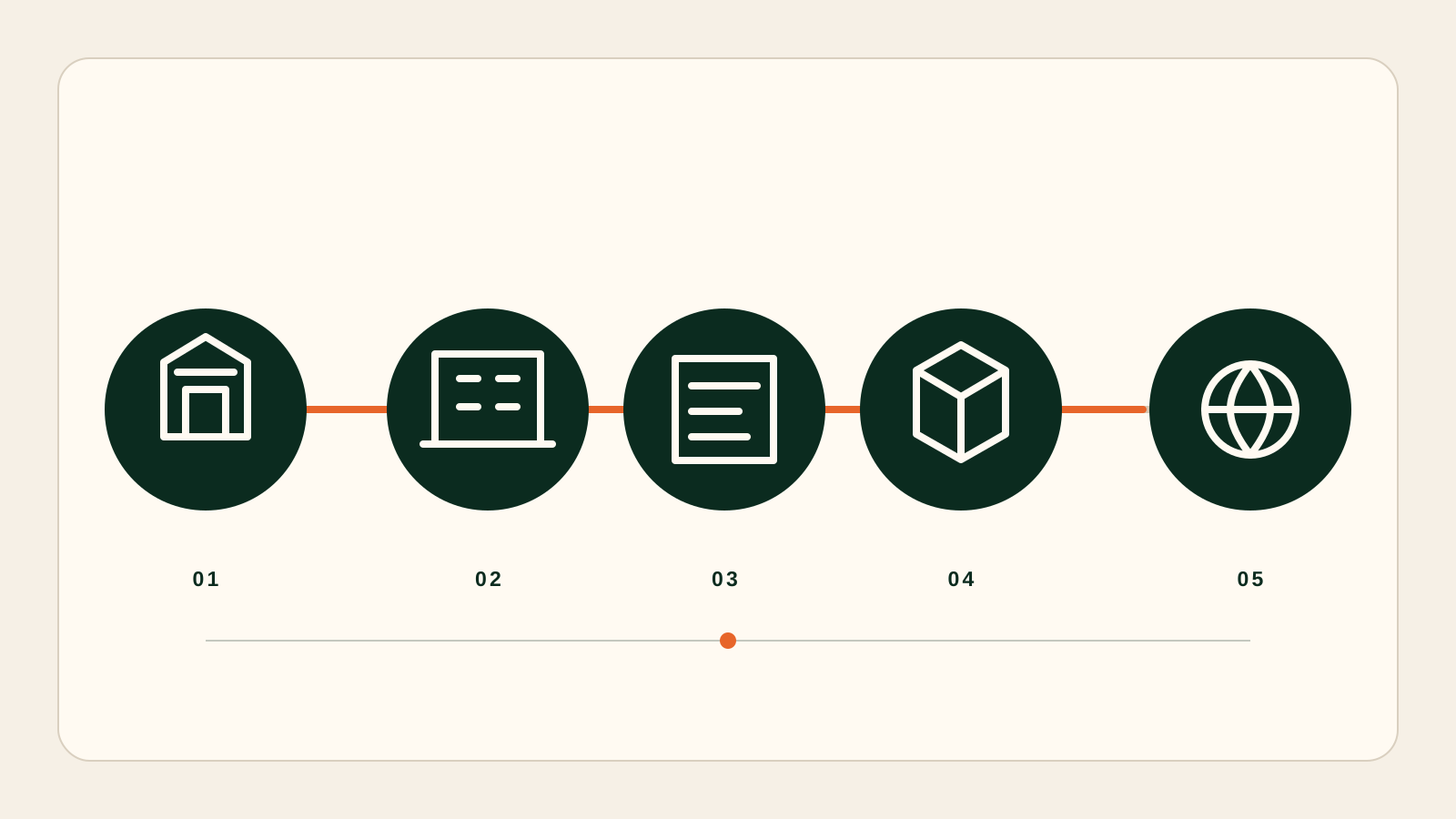
Evaluate a bulk matcha supplier in two stages. First, apply non-negotiable evidence gates: verify the legal and production entities, site and certificate scope, lot-level traceability, product specifications and COA, destination-specific hazard controls, change control, and scale-up records. Only suppliers that pass these gates should receive weighted scores for application fit, consistency, supply reliability, service and landed value. A certificate supports the named system, site and scope; it does not replace batch evidence, destination review or production-scale validation.
USE THIS GUIDE IF
- Ingredient procurement and quality teams qualifying bulk matcha for beverages, bakery, desserts, premixes or retail products.
- Importers, food manufacturers and brands comparing direct suppliers, OEM, ODM or private-label partners.
- Buyers who need an auditable decision file rather than a price-led shortlist.
NOT THE RIGHT ROUTE IF
- Consumers choosing matcha for personal whisking or ceremonial preference.
- Buyers seeking a universal pass/fail specification without defining destination, product category and end use.
- A substitute for advice from the buyer’s regulator, importer, customs adviser, accredited laboratory or legal counsel.
PROJECT DECISIONS
Seven evidence gates to clear before a supplier receives a weighted score
Start with rejection gates, not a supplier beauty contest
Supplier presentations often place legal identity, certificates, samples, prices and service promises on the same page. They are not equivalent evidence. A low quote cannot compensate for an unexplained production entity, an out-of-scope certificate, an unlinked COA or a destination-control gap. The first decision is therefore not “Which supplier scored highest?” It is “Which supplier has supplied enough attributable evidence to remain under consideration?”
Treat each hard gate as PASS, HOLD or REJECT. HOLD is appropriate when a record is missing, unclear or awaiting confirmation; an unsuccessful database search alone should not become a public accusation that a company or certificate is invalid. Resolve the gap with the issuing authority, certification body or supplier. Only after every required gate passes should price, innovation, communication and service influence the ranking.
Bind every claim to an evidence chain
Build the file in this order: legal entity → production site → specific product → specific lot → destination and end use. Record the contract party, payment recipient, producer, packer and exporter separately when they are not the same company. An intermediary is not automatically unacceptable, but the relationship and responsibility chain must be documented so the buyer knows who makes, tests, releases and ships the product.
For a China-based supplier, the National Enterprise Credit Information Publicity System can support checks on the registered entity and unified social credit code, while the State Administration for Market Regulation’s service portals provide relevant food-production licensing lookup routes. Equivalent official systems should be used elsewhere. These records support identity and licensing checks only; they do not independently prove factory ownership, large capacity, export qualification, product quality or commercial reliability.
Read certificates by site and scope
A food-safety management certificate is useful only when it belongs to the correct legal entity or production site and covers the relevant activity. Check the standard and version, certificate number and status, exact address, certified scope, issue and expiry dates, certification body and accreditation body. IAF CertSearch or the relevant programme registry can help verify records, although absence from one database should lead to further confirmation rather than an automatic fraud allegation.
ISO 22000:2018 describes a food-safety management system incorporating established food-safety principles, but ISO itself does not certify companies. Likewise, GFSI recognises certification programmes; it does not issue a generic “GFSI certificate” to a factory. Even a valid, in-scope certificate remains system-level evidence. It does not prove that a particular matcha lot meets the buyer’s specification, residue limits, microbiological needs or finished-product performance.
Separate traceability, specification and batch evidence
Codex describes traceability as the ability to follow food movement through production, processing and distribution. For bulk matcha, the buyer should be able to select a finished-product lot and follow it backward to relevant raw-material and production records, and forward to stock and dispatch records. The practical file may include lot coding rules, production date or shift, ingredient or raw-material references, test records, inventory movements and customer shipment references.
Traceability enables investigation and recall but is not proof of safety, authenticity or origin by itself. Batch conformity needs a separate chain: an approved and version-controlled product specification, plus a COA or equivalent release record for the actual lot. The COA should identify product and lot, sampling or testing date, tests, methods, units, results and laboratory. Buyer sampling, independent testing and test frequency should be risk-based rather than assumed to be identical for every project.
Design hazard checks for the destination and application
There is no single worldwide pesticide or microbiological specification for “matcha.” Requirements depend on where the product will be sold, how the food is categorised, whether it is consumed directly or undergoes further processing, and the current rules of the destination. The European Commission’s MRL database, for example, is relevant to food placed on the EU market; it is not a global residue table. Regulation (EC) No 2073/2005 likewise applies microbiological criteria by defined organisms, food categories and conditions rather than establishing one universal matcha list.
Create a project matrix that identifies the relevant hazard, analytes or organisms, applicable limit or buyer specification, method, LOQ where relevant, sampling plan, laboratory and decision owner. Confirm product mapping rather than assuming a generic tea report covers the intended matcha. Document review also cannot establish application performance: colour in the buyer’s formula, dispersion, sedimentation, heat response and flavour balance require tests under the real recipe and process.
Control change and move from sample to scale
Supplier qualification is not permanent. Require written advance notice for material changes to raw materials, formulation, process parameters, equipment, production site, key suppliers, packaging or test methods. The buyer should define which changes require document review, a new sample, an application test, a pilot or first-lot review. IFS Food v8 offers a useful private-standard model through risk analysis, factory trials, product tests, process monitoring and recorded results, but it is not a law or a universal requirement for every transaction.
Use staged approval: document review, laboratory sample, application test, controlled scale-up, first commercial lot and continuing batch monitoring. Freeze the test formula, preparation method, processing conditions and acceptance criteria before comparing samples. Record what passed and under which conditions. A 50-gram sample can support formulation decisions; it cannot, by itself, demonstrate that a one-tonne commercial batch or later batches will reproduce the same outcome.
Score qualified suppliers, then open the development project
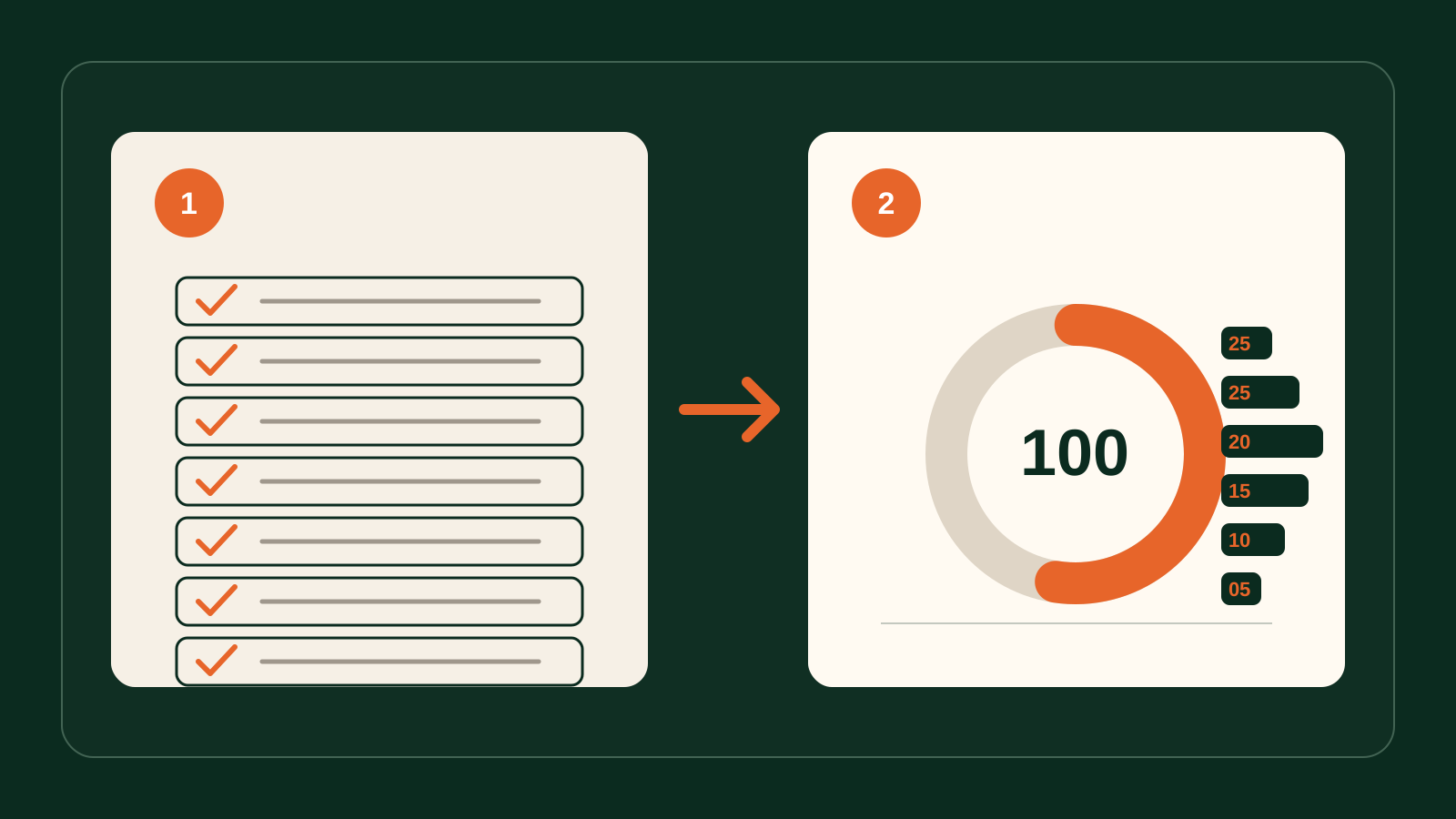
After the hard gates pass, use a buyer-adjustable 100-point score rather than treating it as a universal legal standard. A practical starting allocation is: application and specification fit, 25 points; batch evidence and consistency controls, 25; traceability and change-control execution, 20; supply and commercial reliability, 15; development communication, 10; and landed value, 5. Require a document, test or recorded performance basis for every score. Do not award points for attractive claims that cannot be attributed to an entity, site, product or lot.
XIAO TEA’s role in this framework is that of a custom flavored matcha specialist and professional B2B supplier: translating a buyer brief into matcha-base and flavor matching, testing in the intended application, adjusting sensory balance, and moving an approved direction toward controlled scale-up and repeat-order specifications. This article does not assert that XIAO TEA holds any particular certificate or that any site has passed these gates. For a custom project, the current development route is USD 1,000 for up to five flavors, 50 g per flavor, international courier included and two adjustment rounds after sample receipt; after commercial cooperation, USD 500 may be credited to the goods payment. MOQ is one metric tonne per approved flavor. Start one evaluation project by sending the destination market, application, process, packaging format, forecast demand range and required evidence list.
EVIDENCE BOUNDARY
Evidence is useful only when it remains attached to the entity, site, product and lot.
This framework explains how buyers can organise supplier evidence; it does not validate a named supplier, certify a production site or establish destination compliance. Final test items, legal limits, import documents and release responsibilities must be confirmed for the actual destination and end use with the buyer’s qualified regulatory, importing and laboratory resources.
- Author
- XIAO TEA Application & Commercial Team
- Published
- 1 September 2026
- Review trigger
- Commercial terms, application evidence, regulatory sources or process scope changes
REFERENCE SOURCES
Official and primary references
- National Enterprise Credit Information Publicity System (China)
- State Administration for Market Regulation Government Service Platform (China)
- Codex — General Principles of Food Hygiene, CXC 1-1969
- Codex — Principles for Traceability/Product Tracing, CXG 60-2006
- FDA — Final Guidance for Industry: Foreign Supplier Verification Programs
- European Commission — Maximum Residue Levels
- Regulation (EC) No 2073/2005
- ISO 22000:2018
- IAF CertSearch — Certificate Verification Guide
- IFS Food Standard, Version 8
RELATED QUESTIONS
Questions buyers ask next
Is an ISO 22000 certificate enough to approve a bulk matcha supplier?
No. It can support management-system conformity for the named site and scope. Buyers still need product specifications, lot-linked evidence, destination-specific hazard review, traceability and scale-up verification.
Should a supplier fail automatically if a certificate is absent from one database?
No. Place the item on hold and verify the certificate with the certification body, accreditation route or relevant scheme registry. A database gap alone is not proof of invalidity.
Can one COA prove that a matcha lot complies in every country?
No. The tests, analytes, limits, methods and product mapping must be reviewed against the actual destination and intended use. A COA is also only meaningful when it is tied to the specific product and lot.
Why must price be scored after the evidence gates?
Because a lower price cannot correct an identity, scope, traceability, hazard-control or batch-evidence failure. Price becomes comparable only after the shortlisted suppliers meet the buyer’s non-negotiable risk controls.
Does an approved laboratory sample prove commercial-batch performance?
No. It confirms performance only under the recorded sample conditions. Approval should proceed through application testing, controlled scale-up, first-lot review and continuing batch monitoring.